
Aerobic vs Conventional Septic Systems in Texas: Which Does Your Property Actually Need?
A practical guide for rural Texas homeowners deciding which septic system to install or replace.
Engco Field Notes
- Read Time7 minutes
- TopicTexas Septic Guide
- Last Updated2026
- RegionStatewide Texas
This guide walks you through the decision the way an experienced septic designer would. By the end, you should know which direction your property is headed and what questions to ask the installers bidding your work.
The two systems you’ll be choosing between
In Texas, the vast majority of residential properties install one of two on-site sewage facility (OSSF) types:
Conventional septic system
A conventional system uses a buried septic tank connected to a drain field (also called a leach field or absorption field). Wastewater flows from the home into the tank, where solids settle and partial treatment happens. The liquid effluent then flows out to the drain field, where it filters through the soil. The soil itself completes the treatment.
Conventional systems have been the standard for residential septic in the United States for over 50 years. They are simple, mechanical, and relatively maintenance-free when designed and sized correctly.
Aerobic Treatment Unit (ATU)
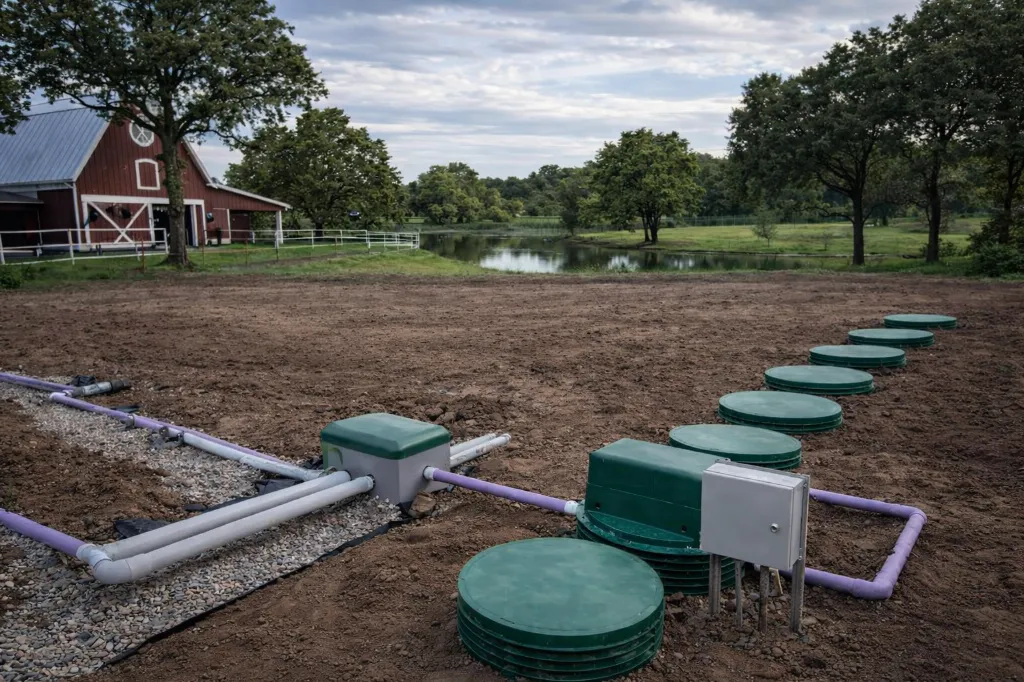
An aerobic system uses a buried treatment tank that injects air into the wastewater, accelerating bacterial breakdown. The treated effluent is then disinfected (typically with chlorine tablets) and sprayed across the property surface through irrigation-style sprinkler heads.
Aerobic systems are mechanically active. They have pumps, blowers, and timers that require electricity to operate. They produce a higher quality effluent than conventional systems and can be permitted on sites where conventional systems cannot.
Why this decision usually isn’t yours alone
Most Texas homeowners assume they get to choose between conventional and aerobic based on preference or budget. That’s not how it works.
TCEQ rules dictate which systems are permitted on which sites. Your soil type, soil depth, lot size, distance to groundwater, distance to property lines, and distance to wells (yours and neighbors’) all determine which systems can legally be installed on your property.
In many cases, your property allows only one option. The “decision” is really a confirmation of what the site can support. In other cases, both systems are technically permitted, and you get to weigh tradeoffs.
The first step in any septic decision is a site evaluation by a Texas-licensed Designated Representative (DR) or licensed Professional Engineer. This is not optional. TCEQ requires a site evaluation before any OSSF permit is issued. The evaluation determines which systems your site qualifies for.
What the site evaluation actually checks
The licensed evaluator inspects and documents:
- Soil type and texture: sandy, loamy, clay, or rocky soils all behave differently for wastewater absorption
- Soil depth to limiting layer: how far down before hitting bedrock, hardpan, or groundwater
- Restrictive horizons: layers of soil that block water movement
- Groundwater depth: seasonal high water table elevation
- Slope and topography: gradient of the land affects flow and absorption
- Setback distances: required separation from wells, property lines, water bodies, and structures
- Lot size: minimum lot sizes apply for certain system types
- Floodplain status: properties in 100-year floodplains have additional restrictions
When you’ll need an aerobic system
Texas properties typically end up needing aerobic systems when:
- Soil absorption capacity is poor. Dense clay soils, rocky soils, or shallow soils don’t allow conventional drain fields to function. The soil cannot adequately filter and absorb the partially treated effluent from a conventional tank.
- Lot size is too small for a conventional drain field. Conventional systems require larger absorption fields. Smaller lots may not have the square footage required for the drain field plus required setbacks.
- Groundwater is shallow. When the seasonal high water table is too close to the surface, conventional drain fields cannot operate without contaminating groundwater. Aerobic systems with surface application can be permitted where conventional cannot.
- Setbacks cannot be met. If the property cannot accommodate the required separation from wells, property lines, or water bodies for a conventional drain field, aerobic systems sometimes offer more flexibility because surface application areas can be configured differently.
- An existing conventional system has failed. When a conventional system fails on a property that no longer meets current TCEQ standards for conventional systems, replacement typically requires an aerobic upgrade.
A significant portion of new Texas residential construction defaults to aerobic systems for one or more of these reasons. In some Central and East Texas counties with poor soils, aerobic is the only viable option for most lots.
When a conventional system still makes sense
Conventional systems remain the better choice when:
- Soils are suitable. Well-draining sandy or loamy soils with adequate depth absorb effluent the way conventional drain fields are designed to work.
- Lot size accommodates the drain field plus all setbacks. Larger rural lots typically have more than enough space.
- Groundwater is sufficiently deep. Most TCEQ rules require several feet of unsaturated soil between the drain field and the seasonal high water table.
- The homeowner wants the lowest possible maintenance burden. Conventional systems have no moving parts. No pumps, no blowers, no chlorinators, no timers. Tank pumping every 3–5 years is the primary ongoing maintenance.
- The property has no reliable electricity. Aerobic systems require continuous electrical service. Conventional systems do not.
Conventional systems are still the most common septic installation in rural Texas counties with favorable soil and lot conditions. If your site allows it, conventional usually wins on lifetime cost and maintenance simplicity.
If your site qualifies for conventional, install conventional. It costs less to install, less to maintain, and lasts longer with fewer service calls.
Cost ranges (and why they’re so variable)
Septic installation costs in Texas vary widely. Here are typical ranges for residential systems in 2026, before any unusual site conditions:
Texas residential systems · 2026
Conventional vs Aerobic: cost comparison
| System Type | Typical Installation Cost | Annual Maintenance | 20-Year Lifetime Cost |
|---|---|---|---|
| Conventional | $8,000–$15,000 | $200–$400 | $12,000–$23,000 |
| Aerobic (ATU) | $12,000–$25,000 | $400–$700 | $20,000–$39,000 |
Several factors push costs up or down within these ranges:
- Site complexity. Rocky soils, sloped terrain, or difficult access drives installation cost higher.
- Drain field type. Conventional systems can use gravel-filled trenches, chamber systems, or low-pressure dosing (LPD). Each has different cost profiles.
- Tank size. Required tank capacity is based on the number of bedrooms in the home. More bedrooms means larger tanks and higher cost.
- Aerobic spray field configuration. The required spray field size depends on system flow rate and effluent quality. Larger required areas drive cost up.
- Permit and inspection fees. Vary by county and authorized agent.
- Maintenance contracts. TCEQ requires aerobic systems to have a continuous maintenance contract with a licensed maintenance provider. This is an ongoing cost conventional systems don’t have.
The aerobic lifetime cost premium over conventional is significant. Over 20 years, an aerobic system costs $8,000–$16,000 more than a conventional system on the same property. This is one reason homeowners push for conventional when their site qualifies for it.
The maintenance reality nobody tells you
Aerobic systems require active maintenance that conventional systems do not.
- Chlorine tablets must be replenished regularly (typically monthly) to maintain disinfection. Failure to maintain chlorine results in untreated effluent being sprayed across the property surface, which is a public health issue.
- Air compressor/blower maintenance. The blower that aerates the tank runs continuously. Failure means the system stops treating wastewater. Blower replacement runs $300–$800 every 5–10 years depending on system brand.
- Spray heads and field maintenance. Spray heads can clog, freeze, or fail. The spray field must remain accessible and free of obstructions.
- Required maintenance contracts. Texas TCEQ rules require a maintenance contract with a licensed maintenance provider for aerobic systems. The provider must inspect the system on a regular schedule (typically every 4 months) and report findings to the local permitting authority.
Conventional system maintenance is much simpler:
- Tank pumping every 3–5 years (the only major recurring maintenance)
- Visual inspection of the drain field area for surfacing wastewater (a sign of failure)
- Avoid driving over or building on the drain field
Many homeowners who inherit aerobic systems from previous owners discover the maintenance burden only after they take ownership. If you’re buying a property with an existing aerobic system, factor the ongoing maintenance contract into your operating budget.
What to ask before you commit
Whether you’re building new construction, replacing a failed system, or buying a property with an existing system, ask these questions before you commit:
Before installation
- Who performed my site evaluation, and are they a Texas-licensed Designated Representative or Professional Engineer?
- What soil class did the evaluation identify, and what does that mean for the system options I qualify for?
- Did the evaluator identify any setback issues that limit my choices?
- What is the seasonal high water table depth on my property, and how was that determined?
- Are there alternative system types my site qualifies for that the contractor isn’t proposing?
Before signing an installation contract
- Is the contractor licensed by TCEQ as an Installer II or higher?
- What permits will be pulled, and is the cost of permits included in the bid?
- What warranty applies to the installation, and what warranty applies to the components?
- For aerobic systems: which maintenance provider is the system enrolled with, and what is the maintenance contract cost?
- What is the schedule for inspections during installation, and which inspections does the local permitting authority require before backfill?
For properties with existing systems
- Is the existing system permitted with the local permitting authority, and is the permit current?
- For aerobic systems: is there an active maintenance contract, and when was the last inspection report filed?
- When was the tank last pumped, and are there records?
- Are there any prior service calls, repair records, or compliance issues on file?
- Can you provide an inspection by an independent licensed septic professional before closing?
When you should call an engineering firm
For most rural Texas homeowners installing a residential septic system, a licensed Designated Representative (DR) and a TCEQ-licensed installer handle the entire process. You don’t need an engineering firm for a standard residential installation.
You should bring in an engineering firm when:
- You’re building a custom home on rural land and the septic system is part of a broader project (foundation, civil site work, water well, driveway). Coordinating these from a single firm prevents the integration problems that come from hiring four or five separate contractors.
- Your property is being developed for multiple lots (subdivision, custom community, multi-home rural development). Subdivision-scale septic planning is engineering work, not single-home installer work.
- Your property has unusual or complex site conditions (steep slopes, large lot sizes for commercial septic, environmentally sensitive areas) that go beyond what a standard residential installer is equipped to handle.
- You’re a developer or commercial property owner with septic on a commercial site (offices, retail, restaurant, multi-tenant facility). Commercial septic is engineered, not just installed.
Engco’s septic and environmental engineering team works on commercial septic design, subdivision-scale septic planning, environmental site assessments, and integrated project work where septic is one component of a larger custom home or land development scope.
The decision in one sentence
If your site qualifies for conventional, install conventional. It costs less to install, less to maintain, and lasts longer with fewer service calls. If your site requires aerobic, plan for the higher lifetime cost and the active maintenance burden, and factor the maintenance contract into your annual operating budget.
A licensed Designated Representative or Professional Engineer can tell you which direction your property is going to go before you sign any contracts.
On this page
- The two systems you’ll be choosing between
- Why this decision usually isn’t yours alone
- What the site evaluation actually checks
- When you’ll need an aerobic system
- When a conventional system still makes sense
- Cost ranges (and why they vary)
- The maintenance reality nobody tells you
- What to ask before you commit
- When you should call an engineering firm
- Frequently asked questions
FAQ
Frequently asked
questions.
How long does septic installation take in Texas?
Permitting and site evaluation usually take 2-4 weeks. Installation itself typically runs 3-7 days for residential systems, depending on system type and site conditions. Aerobic systems take slightly longer to install than conventional due to the additional components (treatment tank, pumps, spray field).
Do I need to live full-time on the property for an aerobic system to work?
No, but the system needs continuous electricity and the chlorine tablets need to be replenished on schedule. Vacation homes or part-time residences with aerobic systems often see service issues when the system runs without active monitoring.
Can I install a septic system myself in Texas?
No. Texas requires a TCEQ-licensed Installer II or higher to install on-site sewage facilities. Homeowner-installed systems are not permitted under TCEQ rules.
What happens if I don’t maintain my aerobic system?
The system continues running but stops treating wastewater properly. Untreated effluent gets sprayed across the property surface, creating health hazards. Local permitting authorities can issue violation notices, fines, and in extreme cases require system replacement.
How long do septic systems last?
A well-designed and properly maintained conventional system can last 30-50 years. Aerobic systems typically last 20-30 years, with major components (blowers, pumps) requiring replacement every 5-10 years during the system’s lifetime.
What if my soil test comes back as unsuitable for any septic system?
Some properties cannot support any on-site sewage facility under current TCEQ rules. In those cases, alternative wastewater systems (such as low-pressure dosing systems, drip distribution systems, or shared systems with neighbors) may be possible. A licensed Professional Engineer can evaluate whether engineered alternatives are viable for your site.

More from Insights
Related Insights.
5 Signs You Need a Structural Engineer
Planning a big project or living in an older building? A structural engineer can help you avoid costly problems. Maybe you’re about to start a…

A Guide to Structural Engineering
Structural engineering decisions can affect nearly every stage of a development project. From foundation requirements and material selection…
Got a Texas project that involves septic?
If septic is part of a larger project, we should talk.
ENGCO’s septic and environmental team works on commercial septic design, subdivision-scale septic planning, environmental site assessments, and custom home projects where septic is one component of a larger build. If you’re a developer, custom home builder, or commercial property owner with septic in scope, our integrated approach saves coordination time across the project.